Distributed Tracing Made Easy with .NET Core

summary
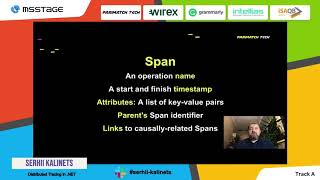
Shows a working .NET Core 3.1 microservices demo that wires the Activity API to the W3C Trace Context (traceparent) headers, propagates context over HTTP and RabbitMQ, and exports traces to Jaeger and Zipkin via OpenTelemetry exporters. Explains setting Activity.DefaultIdFormat for .NET Core 3.1 (not needed in .NET 5), how to add tags and baggage to carry customer/order IDs across services, and that built instrumentation for ASP.NET Core, HttpClient, SQL and Azure Service Bus actually produces searchable end‑to‑end traces.
AI-written summary · about
chapters (15)
- 0:00Start
- 2:25Stack Trace
- 6:53Zipkin
- 7:28Trace Id
- 10:21W3c Trace Context
- 10:53Distributed Tracing Made Easy with Net Core
- 13:14The W3c Trace Context Standard
- 15:01Open Telemetry
- 18:08Basics of the Activity Api
- 19:59The Activity Api
- 21:59Breakpoints
- 25:51W3c Trace Context Format
- 29:49Diagnostic Listener
- 38:59Exporter Libraries
- 1:01:47Does the Net Framework 472 Support Open Telemetry
related talks
 41mDistributed Tracing in .NET
 51mOpenTelemetry tracing for .NET developers
 56mGetting started with OpenTelemetry in .NET
 01h 01mLogging, tracing and metrics: instrumentation in .NET and Azure
 01h 00mPractical OpenTelemetry for .NET
 48mHandling non-functional requirements in .NET Core microservices
 54mLogging, Metrics and Events in ASP NET Core
 59mOpenTelemetry will save your day and night