Deep Learning Architectures for Semantic Relation Detection Tasks
summary
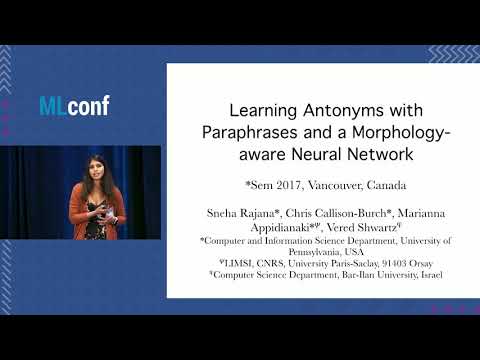
Creates a ~200k-pair labeled set by expanding WordNet (3k direct → +14k indirect) and mining PPDB paraphrases (80k from not‑XY → +25k → +81k after expansion), with a 65% sampled accuracy versus WordNet’s ~70%. Trains an integrated model that concatenates LSTM path embeddings (dependency-edge embeddings from Wikipedia) with GloVe word vectors; adding a negation flag and replacing negated token embeddings with their base forms raises F1 and the integrated model beats lexical/path or distributional baselines, binary classification outperforming multi‑class due to class imbalance.
AI-written summary · about
chapters (24)
- 0:00Intro
- 0:55Challenges of NLU
- 1:57Lexical Semantic Relations
- 2:47What are Antonyms?
- 3:14Goal: Antonym Detection
- 6:05WordNet Seed Set
- 6:50Antonyms from Paraphrases
- 8:08Indirect Antonyms via Expansion
- 8:58Antonym Generation
- 9:47Antonyms derived from PPDB
- 11:40Background
- 12:23Distributional Approach
- 13:00Supervised Distributional Methods
- 14:20Path-based Approach
- 15:07Supervised Path-based Method
- 15:44Neural path-based method HypeNET
- 18:22Term-pair Classification
- 20:52Replacement of word embeddings
- 21:59AntNET: Network Architecture
- 22:22Integrated Model
- 23:39AntNET: Results
- 24:13Effect of the negation-marking feature
- 25:02AntNET: Evaluation
- 25:40Artifacts
related talks
 01h 30mRelation extraction from texts
 39mSemi-Supervised Bootstrapping of Relationship Extractors
 19mNew York Times' Connections: A Case Study on NLP in Word Games
 36mEnhanced and Efficient Reasoning in Large Language Models
 01h 31mNatural Language Understanding: Foundations and State-of-the-Art
 51mEfficient Deep Learning with Humans in the Loop
 49mDeep Learning Applied to Natural Language Processing (NLP)
 38mUnderstanding and Applying Self-Attention for NLP