Quoc Le, Software Engineer, Google
summary
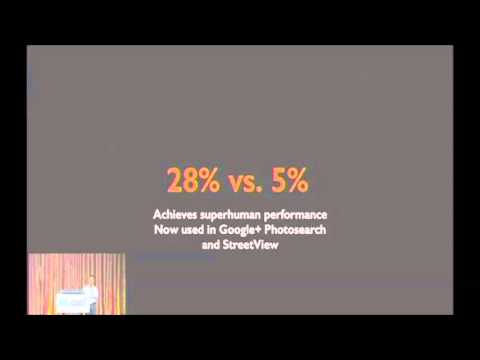
Code and models are released at tensorflow.org, with full source so researchers can reproduce results. A sequence-to-sequence recurrent model handles translation, conversation modelling and speech recognition and matches prior best baselines. Large-scale training runs on thousands of machines (example: 16,000 CPUs) to train networks with about a billion synapses. Empirical gains include image error dropping from ~28% to ~5% and speech word-error falling from ~30% to ~8%, demonstrating practical, production-grade improvement.
AI-written summary · about
chapters (16)
- 0:00Introduction
- 1:20Motivation
- 3:28Deep Neural Networks
- 7:00Parameter Server
- 8:04Shallow ML
- 8:59YouTube Deep Learning
- 9:57The watershed moment
- 10:14Machine learning can invent features
- 10:54Googles ML platform
- 11:19Image recognition
- 12:09Voice search
- 13:22Text understanding
- 16:02Training
- 18:51Meaning of life
- 23:01Tensorflow
- 24:36Questions
related talks
 24mQuoc Le, Software Engineer, Google
 07mMachine learning at Google
 26mUsing deep learning in natural language processing
 59mMachine Intelligence at Google Scale
 09mInterview with Martin Görner
 27mKeynote - Google Cloud, Machine Learning
 13mTaking Machine Learning to the Next Level
 04mState-of-the-art Machine Learning research with Google tools