Towards Practical Algorithms for Outlier-Robust Estimation
summary
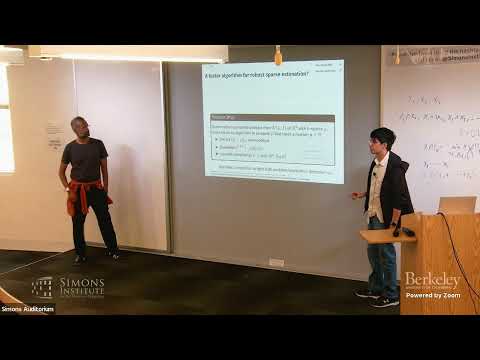
Claims the first algorithm for sparse mean estimation with provable sub-quadratic runtime (for any Q>3) while maintaining near‑optimal error and sample complexity polynomial in k and log d with no explicit dependence on d. It achieves this by reducing the sparse PCA step to a correlation‑detection / light‑bulb primitive so covariance never needs to be written down. Current limits: requires Gaussian inliers, is not differentially private, and is sub‑quadratic but not yet linear time.
AI-written summary · about
chapters (16)
- 0:00Introduction
- 1:08Outliers disrupt ML pipelines
- 2:11Robust mean estimation challenge
- 3:16High-dimensional robust algorithms
- 3:58Algorithm design metrics
- 4:38Sparse mean estimation runtime
- 6:43Quadratic runtime barrier
- 7:28Subquadratic sparse mean estimation
- 8:10Minimal-resource ML directions
- 10:37Future directions and open problems
- 10:58Extending robustness beyond mean
- 12:25Outliers in classification
- 13:28Partitioning inliers and outliers
- 13:51Privacy in robust estimation
- 14:44Information-computation tradeoffs
- 15:46Limitations and next steps
related talks
 45mHigh Dimensional Robust Sparse Regression
 31mTowards Lower Bounds for Efficient Robust Estimation From Worst Case Assumptions
 41mEfficient Algorithms for Outlier-Robust Regression
 31mRealizing Robustness
 09mConvex Programs, Computational Phase Transitions, and Robust Algorithms
 39mAbove Average-Case Analysis?
 01h 00mAlgorithmic High Dimensional Robust Statistics I
 44mSome Problems of Robust High-dimensional Statistics