Semiring Semantics
summary
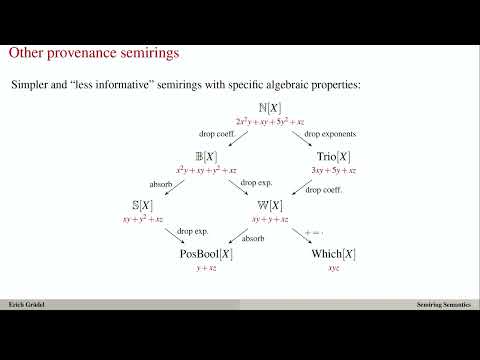
Semiring semantics evaluates formulas in commutative semirings so truth becomes annotated values; negation is handled by translating to negation normal form and using dual indeterminate polynomials modulo x·x̄=0, yielding a universal homomorphism property and polynomials that enumerate proof trees and evaluation strategies. For fixed points the theory requires absorptive fully continuous semirings, which give least/greatest fixed points and a sum‑of‑strategies theorem for Büchi games. Results: provenance, repairs and edge‑profiles follow; many classical theorems generalize only for restricted semirings, and counting strategies can be exponential.
AI-written summary · about
chapters (8)
- 0:00Workshop introduction
- 3:36Semiring semantics basics
- 13:48Limitations of positive queries
- 17:44Handling negation
- 32:02Extending beyond first-order logic
- 44:32Strategy analysis in infinite games
- 53:37Generalizing classical logic results
- 1:03:13Future directions
related talks
 01h 02mAlgebraic Structures in Logic and Query Evaluation 3
 01h 08mAlgebraic Structures in Logic and Query Evaluation 4
 01h 05mAlgebraic Structures in Logic and Query Evaluation 2
 01h 06mAlgebraic Structures in Logic and Query Evaluation 1
 05mRelational Programming
 18mParikh's Theorem Made Symbolic
 24mWhen Less Is More: Consequence-Finding in a Weak Theory of Arithmetic
 36mOptimizing Relational Programs II