Deep Learning and the Relational Algebra
summary
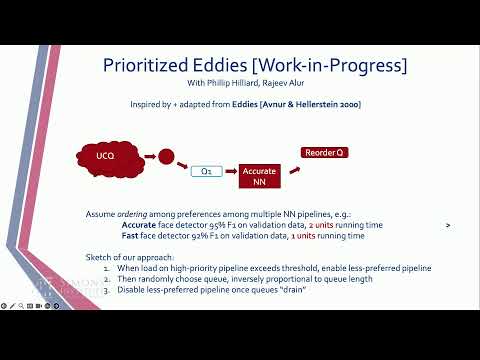
The work extends a standard relational model with a tensor data type and neural operators, treats autograd via a gradient semiring, and implements a prototype that pre-indexes features to apply sideways information passing and threshold bounds during feedforward. On extraction/event tasks the system recomputes views incrementally after small SGD updates instead of rerunning end-to-end, and reports up to 8x speedup versus full PyTorch GPU runs when positive-class frequency is ~10%; GPU still sometimes wins on raw throughput.
AI-written summary · about
chapters (9)
- 0:00Deep learning and relational algebra
- 1:10Databases as web data views
- 5:27Extending algebra with tensor types
- 8:25Neural components in query processing
- 14:33View maintenance with neural updates
- 23:26Speedups from sideways passing
- 25:17Query equivalence in pipelines
- 28:37Open problems and future
- 29:18Q&A on monotonicity
related talks
 17mTowards Iterative Relational Algebra on the GPU
 14mIntroducing RelationalAI
 01h 06mDesign and Implementation of the RelationalAI Knowledge Graph Management System
 01h 00mPostgreSQL and Artificial intelligence
 05mRelational Programming
 27mUnified AI & Relational Power: Scalable Distributed Vector Search with
 25mPostgres and the Artificial Intelligence Landscape
 37mLearned Indexes: a New Idea for Efficient Data Access #bbuzz