Hands on Chat About Categories

summary
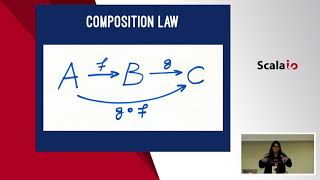
Concrete mappings and runnable examples: definitions of objects, morphisms, identities, composition, Cartesian closed ↔ functions and tuples, explicit constructions of terminal/initial, products, coproducts and exponentials, and how those become code-level types. Demonstrates Scala and Haskell instances, notes Scala’s limits (no built-in equality for functions, stack overflow composing many functions), sketches applicative/monoidal functors in Scala and mentions an ongoing library attempt, and shows which categorical laws are actually tested versus only asserted.
AI-written summary · about
chapters (28)
- 0:00Intro
- 0:12What is a category
- 0:33What ismorphism
- 3:38Monoidal categories
- 6:37Domain operators
- 10:48Vector Spaces
- 13:07Hunters
- 14:57Maps
- 15:48Opposite Categories
- 17:23Phantom Categories
- 20:58Product Categories
- 23:57Identity Categories
- 27:05Symmetric Monoidal
- 28:15Terminal Objects
- 30:40Void
- 31:46Rake
- 33:25Scallop
- 34:16Amorphic
- 35:21Cartesian Categories
- 37:28Exponential Categories
- 43:10Symmetrical Distributive Categories
- 46:17Cartesian Closed Categories
- 47:01Fullfledged programming language
- 47:44Complex functions
- 48:58Eve conditions
- 50:43Box
- 51:30Oil
- 52:27Identity
related talks
 45mA practical introduction to Category Theory
 01h 15mA Crash Course in Category Theory
 36mCategory Theory: An Abstraction for Anything
 48mCategory Theory: You Already Know It
 46mChasing Arrows, in categories containing functors and monads
 55mCategory Theory - Part 3 of 6
 38mCategory Theory as a Tool for Thought
 01h 00mCategory Theory - Part 4 of 6