Category Theory in Life

summary
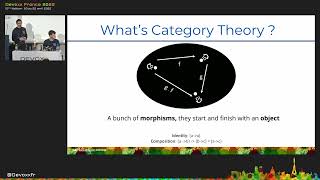
Category theory is presented as a toolkit—objects and morphisms, composition and invertibility, commutative diagrams and universal properties—used to model concrete social systems. Examples map factors of 30 to a cube, model privilege as a skewed poset explaining why rich white non-males sit atop certain contexts, and turn incidents (an airline removal, weight gain, the 2016 election) into causal diagrams showing multiple interacting causes rather than single blame points.
AI-written summary · about
chapters (21)
- 0:00Introduction
- 3:12Outline
- 3:56Category Theory
- 5:34The London Underground
- 6:52Family Trees
- 7:26Categories
- 8:25morphisms
- 8:52composition
- 9:56associativity
- 13:11mathematical
- 13:25natural geometry
- 15:51partially ordered sets
- 17:24privilege
- 20:16sameness
- 23:31cake
- 24:07invertibility
- 27:30universal properties
- 29:07contextuality
- 30:21visual representation
- 32:12United incident
- 38:05Lessons
related talks
 02h 24mCategory Theory Track
 51mCategory Theory for the Working Hacker
 42mWhat did category theory do for us?
 01h 31mCategory Theory Track by Bartosz Milewski Part 2
 52mCategory Theory Through Functional Programming (part 1/3)
 02h 41mCategory Theory: You Already Know It
 01h 11mCategories for the Working Hacker
 56mCategory Theory Through Functional Programming (part 2/3)