Using a Martial Art to Do Tests

summary
Karate claims to give black-box API tests that stay valid when frameworks or languages change by driving real endpoints from a Docker-compose demo (microservice + DB) and comparing responses to external files rather than inlined JSON. Examples show health/info/city endpoints, use of external JSON payloads and matchers like not null, and reuse of the same feature files with Gatling to run a 10-user 20s simulation producing percentile SLAs and HTML/Jenkins reports — the setup works end-to-end.
AI-written summary · about
chapters (14)
- 0:00Introduction and speakers
- 2:36What is Karate and why
- 5:54BDD explained briefly
- 8:22Why use Karate over others
- 10:57Karate use cases overview
- 12:45Karate syntax basics
- 16:43Performance testing with Karate
- 19:14Live demo setup
- 25:27Writing first Karate test
- 34:54Testing real endpoints
- 37:22Performance test syntax
- 43:51Best practices for Karate
- 47:26Summary and resources
- 48:09Q&A session
related talks
 11mUsing a Martial Art To Do Tests
 44mKarate: Beyond API testing
 40mKarate Black Belt in REST API Testing
 01h 00mFull-Stack Test Automation with Karate
 26mKarate for REST and GraphQL test automation
 49mKarate Black Belt in REST API Testing
 16mAPI and UI Test Automation with Karate
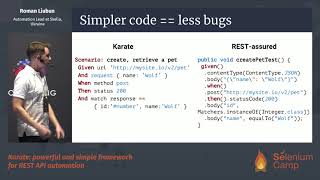 50mKarate: powerful and simple framework for REST API automation