Project Lambda: Simplifying Concurrent Programming in Java SE 8

summary
Claims that Java SE 8 lambdas let library code take iteration and concurrency off application code and make parallelism a one-word change: the serial loop that computes the max 2011 student score becomes a filter‑map‑reduce pipeline that can flip to parallel with a parallel() call. Implementation uses invokedynamic code generation to emit efficient runtime function objects and adds default methods on Collection (filter/map/reduce) to preserve binary compatibility. Demonstration replaces a mutating accumulator with a stateless pipeline and runs correctly via existing fork‑join style execution.
AI-written summary · about
chapters (11)
- 0:00Introduction to Lambda
- 1:12Why Java needs Lambdas
- 8:19History of concurrent programming
- 14:24Serial vs parallel code challenges
- 20:25Problems with anonymous inner classes
- 22:09Project Lambda's goals
- 23:55Lambda syntax and examples
- 30:21How Lambdas work under the hood
- 32:52Default methods in interfaces
- 34:37Benefits of Lambda expressions
- 35:21Q&A session
related talks
 01h 07mJava SE: Lambdas, Streams & Future Directions
 54mParallel-Ready Java Code: Managing Mutation in an Imperative Language
 46mAchieving Functional Programming in Java
 01h 25mJava 8 Language Capabilities, What's in it for you?
 55mTransforming Your Code to Java 8
 56mJava Functional Programming Idioms
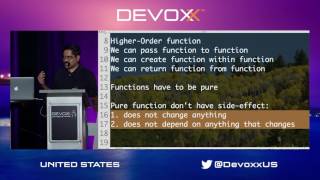 52mFunctional Programming with Java 8
 01h 50mFree Your Lambdas