Speed up software delivery
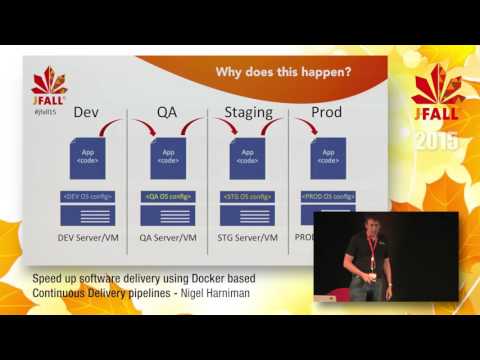
summary
Shows how to turn an app plus its OS/config into a single deployable Docker image and drive it through Jenkins so builds, tests and pushes are automated. Uses Jenkins plugins: build and publish, docker traceability, docker hub notification, docker slaves and a custom build environment, plus the workflow job to script stages. Demonstrates fingerprinting via docker inspect + curl to Jenkins, tags images, pushes to a registry, and the demo pipeline runs end-to-end though the live push is slow over Wi‑Fi.
AI-written summary · about
chapters (12)
- 0:00Introduction to talk
- 2:11Software defines modern products
- 5:21Need for continuous delivery
- 7:48Environment configuration challenges
- 9:10Docker as single deployable unit
- 10:13Jenkins and Docker integration
- 13:42Building and publishing Docker images
- 17:54Docker image traceability
- 22:09Docker Hub notifications
- 25:07Workflow for full pipelines
- 33:58Conclusion and next steps
- 38:55Q&A
related talks
 49mContinuous Delivery at Docker age
 43mLightweight PaaS for Jenkins CI Environments with Docker
 52mBringing Continuous Delivery to Cloud-Scale with Jenkins, Docker and
 52mContinuous Delivery with Containers: The Good, the Bad, and the Ugly
 35mPractical PHP Deployment with Jenkins
 32mFiring up a holistic Continuous Delivery Pipeline
 34mContinuous Delivery with Jenkins Workflow
 36mUsing Jenkins to Build, Deploy, and Automate Projects