Deep Programmability: A New Lens on Networking

summary
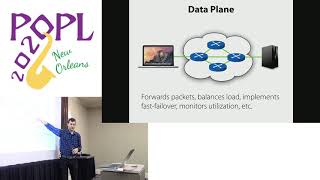
Argues that networks are becoming deeply programmable end-to-end and shows concrete tools: a high-level DSL NetKAT with formal semantics and a compiler that turns a virtual one-switch network into concrete forwarding tables, P4 as an industry data‑plane language with work on formal semantics and verified compilers, and a practical two-phase updates protocol (tags + staged installs) that prevents transient policy violations and is used in production (e.g., Google Cloud). Demonstrations include virtualization, traffic‑engineering, monitoring, and verified compilation; tradeoffs: extra tags and memory.
AI-written summary · about
chapters (16)
- 0:00Start
- 3:23Status Quo: Bottom-Up Design
- 4:39Emerging: Top-Down Design
- 5:48Killer Applications (so far...)
- 10:07Conventional Network
- 14:24Dataplane Model
- 15:50Control-Plane API
- 18:11DSL Design
- 22:56Add a broadcast primitive?
- 26:30Formal Semantics
- 27:10Virtual Compilation
- 28:31Compiler Demo
- 34:01Network Updates in Practice
- 34:44Consistent Updates
- 36:45Two-Phase Updates
- 43:25Some Open Problems...
related talks
 01h 08mThe Network is the Computer: A Programming Language Perspective
 15mEnabling In-situ Programmability in Network Data Plane: From Architecture to Language
 01h 01mNetwork Verification: Past, Present, and Future
 20mContra: A Programmable System for Performance aware Routing
 17mMultitenant In-Network Acceleration with SwitchVM
 18mLiveness Verification of Stateful Network Functions
 28mSafe, Modular Packet Pipeline Programming
 29mOpening Remarks & The State of the Industry