Primal-Dual Algorithms for Hyperbolic Programming Problems

summary
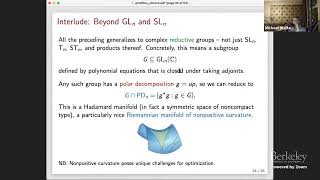
Presents a primal‑dual method that uses the barrier f(x) = -log P(x) for hyperbolic cones, exploits negative curvature (Hessian maps cone into its dual), and follows the central path where the duality gap equals theta·mu. Algorithm minimizes a convex W‑metric (with a rank‑two update when needed), requires evaluating P and its gradient from a straight‑line program, and proves an iteration bound of sqrt(theta) log(1/epsilon); theory guarantees the bound and polynomial‑time behavior given the input format.
AI-written summary · about
chapters (11)
- 0:00Introduction
- 2:20Polynomials and cones
- 6:35Optimization problem setup
- 9:05Feasibility and duals
- 11:45Barrier function properties
- 17:11Geometric insights
- 25:26Local metrics and geometry
- 32:49Central path and updates
- 37:38Algorithmic results
- 43:05Special cone classes
- 44:31Q&A session
related talks
 51mAre Single-Loop Algorithms Sufficient for Unbalanced Minimax Optimization?
 01h 01mDuality 1
 51mMin-max Optimization: From Complexity to Algorithms
 11mGeometric Methods for Machine Learning and Optimization
 01h 02mDuality 2
 01h 12mGeodesic Convexity and Optimization
 01h 11m(Hidden) Symmetries of Computational Problems (continued)
 18mReLU Hull Approximation