CloudMirror: Application-Aware Bandwidth Reservations in the Cloud

summary
Proposes a graph-based tenant application graph that specifies per-VM directional send and receive guarantees and a new placement algorithm that maps that graph onto a tree datacenter to minimize core reservations. Simulations using the Microsoft bing.com communication traces on a 2,000-host, 50-VM-per-host model and comparisons to virtual cluster and VOC show up to 76 percent less total reserved bandwidth and often ~2x savings. Enforcement assumes existing tools like ElasticSwitch and vShaper and a planned OpenStack prototype.
AI-written summary · about
chapters (19)
- 0:00Intro
- 0:32Need bandwidth guarantees for predictable performance
- 2:10Goal: Network Abstraction for Expressing Bandwidth Demands
- 3:09Cloud Mirror Context
- 3:55Solution: Cloud Mirror
- 4:49Pipe Model
- 6:12Virtual Cluster Model
- 6:59Virtual Cluster Example
- 9:36Intuition: Model The Application Not The Network
- 10:48Tenant Application Graph (TAG)
- 11:48Bandwidth Models in TAG
- 13:01TAG is Intuitive
- 13:36TAG is Efficient
- 15:15Flat Per-VM bandwidth while tenant scaling
- 16:28VM Placement
- 18:45Evaluations
- 21:07Conclusion
- 22:48Backup slides
- 25:04Bandwidth demand is proportional to user transaction
related talks
 21mChatty Tenants and the Cloud Network Sharing Problem
 36mNetwork Bandwidth-Aware Kubernetes Cluster
 10mLightning Talk: Closing the Gap: Fair North–South Bandwidth Management for Tenants
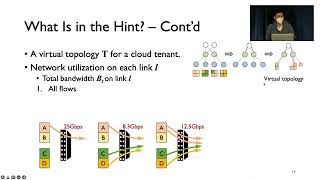 17mNetHint: White-Box Networking for Multi-Tenant Data Centers
 16mPreview: Cloud Computing
 18mCloudcast: High-Throughput, Cost-Aware Overlay Multicast in the Cloud
 16mOptimizing Network Provisioning through Cooperation
 12mCost-effective Cloud Edge Traffic Engineering with Cascara