Boosting your applications with distributed caches/datagrids

summary
Explains how Infinispan 10 (embedded or client‑server) provides replicated and distributed caches with configurable owner count, backups, consistent hashing and cross‑site replication via JGroups; demonstrates a working Vert.x example that uses Infinispan as the cluster manager, a Vert.x clustered event bus, distributed locks and continuous queries to avoid duplicate work (Voldemort/Death Eaters demo). Shows Quarkus native build running the demo, notes JVM image size drops (~140 MB to ~13 MB) and that the demo and native Docker image run successfully.
AI-written summary · about
chapters (16)
- 0:00Introduction
- 1:30What is a data grid
- 3:21Caches vs distributed caches
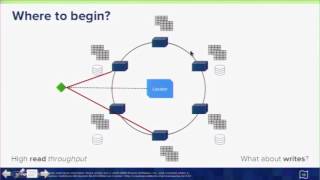
- 7:14Redundancy and ownership
- 9:27Consistent hashing explained
- 12:25Vertex and event bus demo
- 18:42Distributed locks in Vertex
- 21:02Vertex and Infinispan integration
- 23:18Stateful vs stateless apps
- 24:43Client-server mode benefits
- 27:35Modern JVM frameworks
- 29:22GraalVM and Quarkus benefits
- 30:27Hogwarts magic WebSocket demo
- 38:31Quarkus native executable demo
- 41:06Infinispan future API
- 43:13Q&A and resources
related talks
 47mBoosting your applications with distributed caches/datagrids
 38mBoost Your Applications with Distributed Caches/Datagrid
 54mThe JBoss Data Grid, or Enterprisegrade Infinispan
 01h 23mBuilding Highly-Scalable Spring Applications with In-Memory, Distributed Data Grids
 41mDistributed Java DBs Under the Hood: Main Components and Interactions Between Them
 43mCaching and Beyond - Smarter Data Processing with Java
 53mLeveraging Caching For Cloud Native Applications
 33mDistributed Database DevOps Dilemmas? Kubernetes to the rescue!