Structured Concurrency: Hierarchical Cancellation & Error Handling

summary
Structured concurrency demos show concrete APIs and results: Java Loom scopes and jOcks, Kotlin coroutines and Scala effects implement races, hedging and resource-safe tasks; a custom EasyRacer server validates behavior and the repo contains client implementations. Examples include 10,000 concurrent requests on virtual threads, a hedging pattern that delays a second request, and clear semantics for shutdown-on-success vs shutdown-on-error; resource cleanup and many‑to‑many joins pass the obstacle tests.
AI-written summary · about
chapters (21)
- 0:00Intro
- 0:59What is structured concurrency?
- 3:00Races
- 6:05Easy racer
- 7:27Approaches to structured concurrency
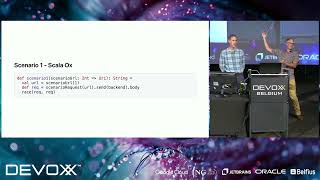
- 9:34Scenario 1
- 10:24Demo
- 18:01Scenario 1 continued
- 27:13Scenario 2
- 27:34Race shutdown on success
- 28:50Race shutdown on error
- 29:20Scenario 2 continued
- 34:20Scenario 3
- 35:55Scenario 4
- 40:22Scenario 5
- 41:58Scenario 6
- 44:44Demo
- 45:50Scenario 7
- 48:03Wrap-up
- 50:05Q&A
- 53:42Outro
related talks
 50mStructured Concurrency: Managing the Hierarchical Cancelation and Error Handling
 01h 02mStructured Concurrency: Managing the Hierarchical Cancelation and Error Handling
 43mStructured Concurrency in Java - The What and the Why
 41mStructured Concurrency in Java: The What & Why
 32mStructured Concurrency: The paradigm shift
 45mTaming the Chaos - Structured Concurrency
 49mJava's Concurrency Journey Continues! Structured Concurrency & Scoped Values
 01h 21mStructured Concurrency