Chip floorplanning with deep reinforcement learning

summary
A deep reinforcement learning pipeline generates chip floorplans for Google TPUs that match or beat expert layouts and runs under six hours instead of weeks. An RL agent sequentially places macros, a force‑directed placer fills standard cells, and a masked action space enforces feasibility. Training uses 10,000 placements across five blocks and an edge-aware graph encoder that predicts wire length and congestion; production TPU layouts from Nature results tape out successfully.
AI-written summary · about
chapters (11)
- 0:00Intro
- 0:24Key takeaways
- 1:41Prior approaches to chip floorplanning
- 2:16Chip floorplanning with reinforcement learning
- 2:44We take a hybrid approach to placement optimization
- 2:55Results on a TPU-v4 block
- 5:32Reward model architecture and features Input Features Graph Cory Predictions
- 6:08Label prediction results on test chips
- 6:49Ariane (RISC-V) placement visualization Training policy from scratch
- 7:49Convergence curve: training from scratch vs. fine-tuning
- 8:33Comparisons with manual and SOTA baselines
related talks
 20mKeynote: ML for Systems and Chip Design
 26mChatGPT and Minecraft's diamonds playing agents: Reinforcement Learning in a nutshell with sheeprl
 26mKeynote: Artificial Innovation Accelerates Artificial Intelligence
 32mByteDance's Platform for Reinforcement Learning from Human Feedback
 17mScaling Reinforcement Learning
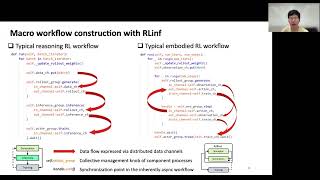 17mRLinf: Flexible and Efficient Large-Scale Reinforcement Learning...
 19mDynaRL: Flexible and Dynamic Scheduling of Large-Scale Reinforcement Learning Training
 37mTensorflow and deep reinforcement learning, without a PhD