Introducing FlinkML

summary
A Flink-based model-serving framework treats exported models as data, uses protobuf model-as-data to carry a binary model blob plus metadata, and stores large models by reference on Cassandra/HDFS/S3 while keeping current model state inside Flink for low-latency scoring. Implementations run TensorFlow and PMML evaluators via a simple model trait, handle key join vs map join (per-key state or broadcast-with-jitter) for scaling, and expose metrics and a limited queryable state (only for key-partitioned joins). Code lives on the Flink GitHub; first version runs but drops events if no model and has queryable-state and broadcast jitter caveats.
AI-written summary · about
chapters (18)
- 0:00Intro
- 1:12How people see ML
- 1:35Reality
- 4:12What is the Model?
- 4:45Model learning pipeline
- 5:58Models proliferation
- 6:52Model standardization
- 8:35Model lifecycle considerations
- 9:21Customer SLA
- 10:19Model Governance
- 13:15Flink Low Level Join
- 14:47Model representation
- 15:50Key based join
- 16:51Partition based join
- 18:30Monitoring
- 19:05Queryable state
- 19:39Where are we now?
- 20:14Next steps
related talks
 40mStreaming ML with Flink
 15mMetamodelization and Automatic Generation of ML Pipelines
 15mData science at scale using Apache Flink: Dynamic model serving and real-time feature generation
 31mBuilding an open-source ML feature store with Apache Flink
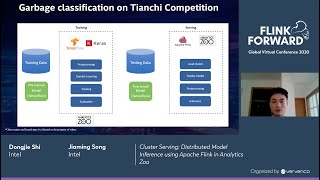 18mCluster Serving: Distributed Model Inference using Apache Flink in Analytics Zoo
 37mBuild a Flink AI Ecosystem
 39mML Inference at scale, with Apache Beam and the Flink runner: Easy as learning your 5 times tables.
 15mFeature Stores: Powering Machine Learning Infrastructure with Apache Flink