How The Web Sausage Gets Made

summary
Begins in 2010 with a proposal that becomes the extensible web manifesto and pushes for low‑level primitives not high‑level widgets. Browsers implement shadow DOM and the element lifecycle, Polymer and other libraries appear to build on it, service workers and polyfills fill gaps, and the V1 spec matures from a 2014 draft to ship in two browsers by 2017. Result: reusable components that work across frameworks (USA Today, Angular adopting), slow but successful in practice.
AI-written summary · about
chapters (49)
- 0:00Introduction
- 1:26Backend
- 2:11Web Standards
- 3:51Big Companies
- 4:19Browser People
- 4:39The Platform
- 5:22The Standards
- 5:49Who Makes The Web
- 6:08Railroads
- 6:51Hot Dogs
- 7:10Buns
- 7:59Date
- 8:18Months
- 8:50Daypickers
- 9:00Date picker
- 9:30Extensible Web Manifesto
- 10:01Accessible Web Manifesto
- 11:46Lonely API
- 11:57Browsers
- 12:31Browser Magic
- 13:02Input Type
- 13:56Nobody liked it
- 14:06The wrong thing
- 14:30Web Component Model
- 14:52Why Web Component Model
- 15:49Standardizing Ideas
- 17:20DOM Elements
- 18:17Done Elements
- 18:39Shadow DOM
- 19:02JavaScript
- 20:00Browser
- 20:49Lowlevel API
- 21:34Browsers do work
- 23:05Trust Issues
- 23:38Polyfills
- 25:46Small and fast
- 25:59Component lifecycle
- 26:59Chicken
- 27:46Questions
- 28:07Reusable
- 28:58Frameworks
- 29:21Can I write DOM without jQuery
- 29:46How things should have gone
- 30:27Do web components toss users overboard
- 31:47Whats next
- 31:58Web Components for Web Standards
- 32:33WICG
- 33:08Web Incubator
- 34:00Thank you
related talks
 26mThe Extensible Web: JavaScript All the Way Down
 43mWeb Components: From 'Why Not?' to 'Why Now!'
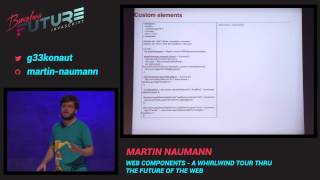 36mWeb components - A whirlwind tour thru the future of the web
 39mProgressive web apps with Polymer
 41mComponents Approach to Building Web Apps
 26mOpening Keynote
 59mIntroduction to Web Components
 19mWeb Components