RISC V Tracing What is Different
summary
RISC‑V adopts a Nexus‑compatible "N‑Trace": a pinout using MIPI‑20, a Nexus encoder option (BTM for basic, HTM for higher compression), and a funnel that can merge RISC‑V and Arm trace streams. Messages use 6‑bit slices/2‑bit T‑codes with 64 T‑codes (12 currently used) and a timestamp at the end. Claimed transmission overhead is about 25% versus Arm’s ~30–40%. SEGGER’s J‑Trace already decodes BTM; HTM support waits for final ratification (targeted Q2 2023).
AI-written summary · about
chapters (20)
- 0:00Intro
- 2:42Introduction - What is tracing?
- 3:40Introduction - Trace types
- 6:16State of the art - How Arm does it
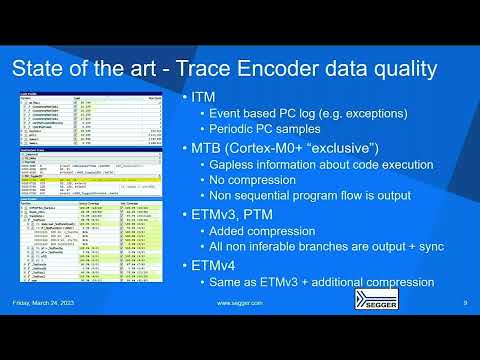
- 9:23State of the art - Trace Encoder data quality
- 12:15State of the art - Timing requirements
- 16:02RISC-V Trace Plan
- 16:51Nexus Standard
- 19:40RISC-V Nexus Trace components
- 21:01Trace component comparison
- 21:45Trace Connector
- 22:14Trace Encoder Features
- 23:49Funnel Features
- 24:38Nexus message format
- 25:57Nexus trace transmission protocol
- 27:32Summary
- 28:40What is good/better?
- 30:41What is bad/worse?
- 34:21Conclusion
- 34:52RISC-V trace at SEGGER
related talks
 19mRatified N-Trace Specifications - an Overview
 18mLeveraging the RISC-V Efficient Trace (E-Trace) Standard
 12mDemo: RISC-V 64 Bit Debug and Trace
 10mLeveraging the RISC-V Efficient Trace (E-Trace) Standard
 14mRISC-V Debugging: Custom ISA Extensions, Multicore, DTM Variants
 16mEfficient debug and trace of RISC-V systems: a hardware/software co-design approach
 04mSiemens Interview
 02h 00mAdvanced Debug and Trace Tools for RISC-V Architectures