Scaling Android Development without a Monorepo

summary
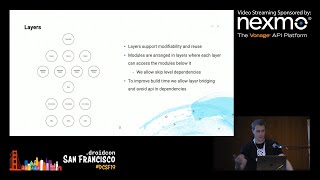
Company converts separate apps into mini‑apps packaged as AARs and composes them into one container app that outputs the final APK. Architectural rules: no feature directly depends on another, features remain optional, and a dependency provider interface supplies analytics, location, maps, etc., implemented by the container so features stay agnostic. Tooling includes KSP for registry generation, library‑izing the container for local dev, Renovate, size‑delta and manifest checks, and source/binary compatibility checks (Kotlin validator, Metalava) plus BOM/version‑catalog dependency alignment.
AI-written summary · about
chapters (16)
- 0:00Scaling without monorepo
- 2:06From separate apps to super app
- 5:20Architectural principles for modularity
- 7:07Feature interfaces and DI
- 10:14Deep link resolution
- 12:21Feature registration and inclusion
- 13:26Library-sized containers
- 14:51CI/CD for modular Android
- 15:55Dependency diff and size checks
- 18:45Manifest and permission validation
- 19:47Compatibility validation
- 24:04Segregating dependencies
- 26:13Distributed development challenges
- 27:35Poem on scaling
- 28:40KMP and iOS trade-offs
- 31:09Closing and Q&A