CI is Essential but not Sufficient for an Effective Application Delivery Workflow
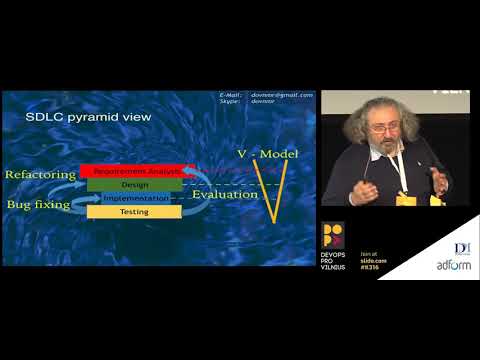
summary
Claims that CI alone fails unless the codebase, tests and pipeline match reality: monolithic code slows CI to unusable builds, no automated unit/security/spec test suite means repeated manual QA, and long‑lived feature branches and shadow deploy steps break delivery rhythm. Practical stack and flow are concrete: Jenkins builds artifacts to Artifactory, images to Quay, infra via Terraform, clusters on Kubernetes with Datadog monitoring, with deploy, migration and rollback stages. Recommendation is to refactor, write the pipeline rules, and keep automation and tests close to the code.
AI-written summary · about
chapters (23)
- 0:00Intro
- 2:25About Dov
- 3:58Agenda
- 4:54Continuous Delivery
- 6:13Why Continuous Delivery
- 7:15What is Continuous Delivery
- 10:20Three Primary Problems that Stop Continuous Delivery
- 12:47monolithic code base
- 13:20monolithic code
- 14:15time
- 14:37quick changes
- 16:05its not my fault
- 16:30story begins
- 16:46Slow build
- 19:57Separate parts
- 20:55Scale cube
- 23:20Design test suit
- 24:08Test pyramid
- 25:05Manual tests
- 28:19Deployment pipeline
- 29:41Workflow example
- 32:55Continuous Integration
- 36:02Conclusion
related talks
 24mCI/CD Best Practices to Deliver Software Faster
 27mArchitect CI/CD on Enterprise level
 23mCI/CD: Conscious Uncoupling
 24mYour CI Pipeline is the Platform
 01h 05mTwelve Essential Practices to be Effective in Continuous Delivery
 32mPractical Tips & Tricks for CI/CD Success
 39mRemove your Testing Bottleneck with CI/CD Pipelines
 17mCI/CD - Build/Deploy Automation