Modeling Graph-Based Morphology of the Synaptic Spine Head

summary
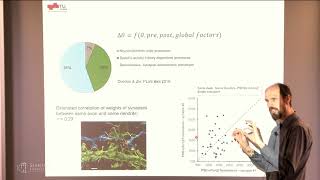
Implements Dynamical Graph Grammars in a Mathematica package called Plenum to stochastically evolve actin filament graphs with rule-based propensities and conditional sampling; adds anisotropic filament forces, filament–membrane mechanical interaction, Lennard‑Jones buckling and Hessian‑Boltzmann sampling for thermal noise, using literature rate constants. Two validated outcomes appear: a network‑only simulation (coarse grain four actin monomers per object) produces a bimodal filament‑link distribution, and a membrane‑enclosed run (coarse grain eight) yields membrane volume growth that doubles relative to the actin skeleton and ends near half the small biological spine head (~0.05 µm³). Future porting to Kete is planned.
AI-written summary · about
chapters (14)
- 0:00Introduction
- 0:27Graph-based modeling theory
- 1:11Biological simulation modules
- 3:22Dynamical graph grammars
- 4:33Network remodeling rules
- 6:41Actin mechanics and membrane
- 9:12Actin skeleton role
- 10:37Graph grammar rules and code
- 13:53Stochastic simulation algorithm
- 16:47Simulation results no membrane
- 17:51Simulation results with membrane
- 19:38Future work
- 21:03Q&A branching mechanisms
- 22:09Q&A hybrid simulation
related talks
 47mDynamic Neural Network Structures Through Stochastic Rewiring
 31mNeuromorphic computing in spiking neuron-astrocyte networks
 31mThe universe as balls and springs: molecular dynamics in Python
 01h 13mComputation in Networks of Neurons in the Brain II
 54mEmergent elasticity in the neural code for space
 31mSimple Models and Exact Algorithms for Computing Network Modules
 51mPlaying Newton: Automatic Construction of Phenomenological, Data-Driven Theories and Models
 12mComputation with sequences of neuronal assemblies