Matei Zaharia, Databricks | Databricks Data + AI Summit 2023

summary
Databricks announces concrete pieces: a Unity Catalog that enforces lineage and access across structured tables and unstructured files, Delta tables that read/write as Iceberg and Hudi to end the “format war,” and a serverless model serving stack plus tooling for heavy GPU training. MosaicML appears via a MosaicML $1.3B acquisition and pooled GPU capacity model. Lakehouse IQ surfaces business queries, and teams warn that evaluating generative output remains an open engineering problem despite demos to 12,000 attendees.
AI-written summary · about
chapters (13)
- 0:00Introduction
- 1:12How does Databricks support generative AI
- 2:30Large language models and generative AI
- 4:30Who controls the data
- 5:58Open interfaces
- 7:31Mosaic ML
- 8:42Training vs Inference
- 10:33Work required to build
- 13:45New modalities of data
- 15:03Data Developer
- 16:16Fuzzy Reasoning
- 17:32Vector Search
- 19:48Heavy Vehicle
related talks
 02h 52mKeynote Day 1 - Full
 23mAnalystANGLE
 49mGenAI for Business on the Modern Data Stack
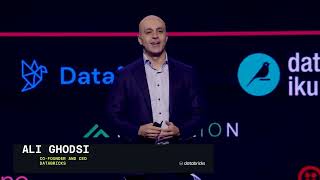 03mDay 2 Opening Remarks
 36mDatabricks as the Foundation for GenAI: What’s New and What Works
 23mKeynote Analysis
 52mElevate your data and AI governance with Databricks Data Intelligence Platform
 49mBuild & deploy generative AI apps in days with Databricks Lakehouse AI