Modelling and predicting customer lifetime value

summary
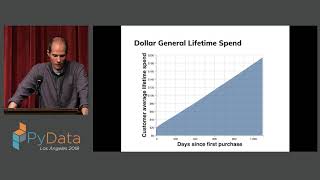
Compares classic Buy Till You Die models implemented with the lifetimes Python package against a custom variational autoencoder + RNN that ingests event sequences (includes time-since-previous-event) and outputs a next-transaction distribution plus a latent churn variable. Tests use a ~100-day cohort (train through Feb, predict Mar–Apr) and show BTYD underpredicts out-of-sample transactions after coarse segmentation; the neural model recovers bimodal clusters on synthetic data, yields uncertainty estimates, and is under active validation before planned open sourcing.
AI-written summary · about
chapters (8)
- 0:00Start
- 4:11Basics of future revenue estimation.
- 4:55The importance of churn.
- 10:05What's going on?
- 11:55And so is the model performance
- 13:11Segmentation choice as hyperparameter.
- 25:48Does it work?
- 27:38Next steps...
related talks
 36mImplementing and Training Predictive Customer Lifetime Value Models in Python
 36mCustomer Lifetime Value: Models, Metrics and a Multitude of Uses
 44mEating Humble Py: From Toy Problem to Real-World Solution in Predicting CLV
 24mUnlocking revenue: newcomer classification for boosted profits
 23mCustom-made games with machine learning and big data
 35mLife, Death, and Shopping
 27mPreventing churn like a bandit
 45mKnow Your Customer