The State of Serverless Computing
summary
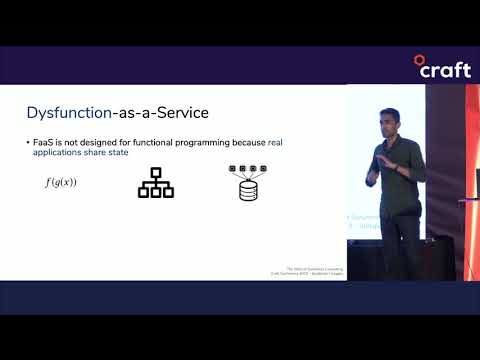
Serverless today limits real-world apps: 15-minute execution time ceilings, disabled inbound sockets, and I/O bottlenecks force state through S3/DynamoDB and add 100–200 ms latency for simple function chains (a laptop runs the same chain ~10,000× faster). A prototype stack uses Anna for fast storage and a runtime called fluent to cache and colocate state, claiming fluent outperforms Lambda by ~100× and beats SageMaker on a prediction pipeline by up to 3×.
AI-written summary · about
chapters (18)
- 0:00Start
- 1:41Making Programmers Productive
- 2:35What is serverless computing?
- 3:34Faas: A Simple Example
- 7:32Wait! What about.
- 8:16Limitations on Faas Today
- 10:15Dysfunction-as-a-Service
- 12:04Even Functional Programming is Slow!
- 14:46Shared Mutable State
- 16:46(In)Consistency Guarantees
- 18:05No Inbound Network Connections
- 18:34Indirect Communication
- 20:38Background: Anna
- 24:10Key Idea: Caching
- 24:35Challenge: Cache Consistency
- 25:33Function Composition, Revisited
- 26:21Prediction Serving
- 29:46Looking Back: Disappointed Computer Scientists
related talks
 42mNo Server Is Better Than No Server: Building Blocks for Serverless Architectures
 01h 00mServerless - reality or BS - notes from the trenches
 41mTechnology mix: Around the serverless in 180 days
 31mAccelerate business innovation with serverless applications
 54mServerless beyond Functions
 47mAdvanced Serverless Architectural Patterns on AWS
 58mServerless - the brief past, the bewildering present, and the beautiful (?) future
 51mConfusion In The Land Of The Serverless