Real-time adaptive controls for resilient container workloads

summary
Engineered an adaptive control layer for Kafka-to-Cassandra workloads that infers capacity from runtime feedback and adjusts worker concurrency, rate limits and autoscaling without a central store. Uses Little’s Law and AIMD congestion control to grow/shrink a per-pod worker pool (examples show 2–5 workers converging to ideal), reallocates client quotas as percentages of total capacity, and prevents Cassandra overload in production. Claims: no centralized coordination, seeds + min bounds converge and autoscaler stabilizes near 80% of theoretical max.
AI-written summary · about
chapters (12)
- 0:00Introduction to adaptive controls
- 1:51Reference architecture overview
- 3:17Challenges with static worker counts
- 4:40Applying Little's Law to capacity
- 6:06Dynamic capacity estimation need
- 7:12AIMD algorithm for concurrency
- 8:37Traditional rate limiting flaws
- 11:06Adaptive rate limiting approach
- 12:31Limitations of traditional auto scaling
- 13:12Adaptive auto scaling strategy
- 16:44Summarizing adaptive strategies
- 17:27Closing and career opportunities
related talks
 37mReal-Time Adaptive Controls for Resilient Distributed Systems
 05mResource Roulette: Winning the Kubernetes Allocation Game
 20mBetter Resilience Through Self Tuning
 38mDynamic Pod Resource Boundary Adjustment in Web Scale Clusters
 31mBeyond the Limits: Scaling Kubernetes Controllers Horizontally
 44mDeep Dive talk | Resilience in Microservices with Congestion Control
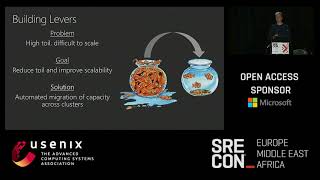 18mAvoiding and Breaking Out of Capacity Prison
 38mDynamic Pod Resource Boundary Adjustment in Web Scale Clusters