Domain-Driven REST
summary
Explains how to apply Domain-Driven Design to building RESTful APIs using concrete criteria: Richardson maturity levels, mapping resources to aggregates, and practical hypermedia (JSON HAL) links. Shows a leave-request example using 202 + Location for async processing with polling, conditional updates via ETag/If-Match that yield 412 on conflict, and recommends explicit media types while noting when RPC or tailored experience APIs are preferable.
AI-written summary · about
chapters (23)
- 0:00REST and DDD intro
- 1:26What REST really is
- 3:53Richardson maturity model
- 6:26Resources IDs representations
- 8:35HTTP methods semantics
- 10:23Hypermedia API navigation
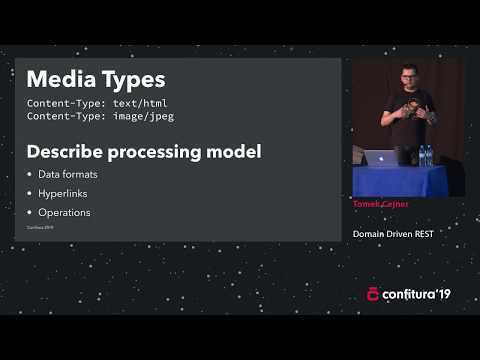
- 12:56Media types contracts
- 17:39REST vs DDD
- 18:42DDD basics bounded contexts
- 20:30Aggregates domain modeling
- 22:40Anemic domain model issues
- 25:29Rich model vs REST conflict
- 28:57HTTP as app protocol
- 30:00Business processes async
- 33:10Vacation request example
- 36:45Temp resources operation status
- 39:16Data consistency locks
- 41:05REST design with DDD
- 42:52REST scalability persistence
- 44:00Avoid DB-style APIs
- 45:47Multi-client API design
- 47:14Bounded contexts book API
- 49:21Q&A
related talks
 50mThe Fashion for REST - Creating Beautiful APIs
 56mDDD & REST - Domain Driven APIs for the Web
 01h 02mHypermedia and the Rest of REST
 54mEffective Design of RESTful APIs
 09mInterview: When Is RESTful API Design Useful?
 53mEffective Design of RESTful APIs
 01h 39mLet’s have some Effective REST
 51mREST beyond the obvious – API design for ever evolving systems