Operable Erlang and Elixir

summary
Argues that complexity is unavoidable at scale and practical operability requires layered visibility, not indiscriminate logging; recommends structured logs, probe placement in frameworks (e.g. middleware) and using VM and OS tools such as sys_trace and dbg, microstate accounting, and DTrace/systemtap/perf to inspect message flows, GC hotspots and syscall latency. Warns automation can worsen failures via the law of requisite variety and advises automating only tasks that can be “half‑assed”; cites OTP 22 process-local logging buffers and recon-style tracing as immediately useful and proven in production.
AI-written summary · about
chapters (6)
- 0:00Start
- 18:49The Law of Requisite Variety
- 21:00What teams do
- 28:15MicroState Accounting
- 30:02DTrace & SystemTap
- 34:07Practice makes perfect
related talks
 39mKeeping tabs on production
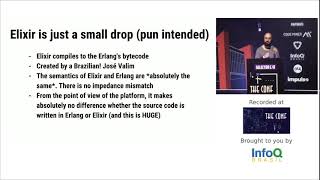 42mIt's about (run)time -- Elixir beyond the hype
 01h 03mThinking Erlang in a connected world
 37mModern Abstractions and the Web, and avoiding Pitfalls because Life is short
 39mPilgrim's Progress to the Promised Land
 41mIdioms for building fault-tolerant applications with Elixir
 49mKeynote: How to sell Elixir (Again)
 03h 19mWorkshop - All Aboard The Elixir Express!