Value Oriented Programming Part V - Return of the Values

summary
Argues for making types behave like values to reduce entanglement and accidental sharing, shows concrete fixes: a camera class trimmed of transient fields, a graph implemented as an adjacency matrix stored as bitset-backed vector with a maintained dimension invariant and a separate graph‑coloring solver (coloring is NP‑hard so solver is heuristic), a projector mapping pipeline that returns thousands of correspondences (move‑returned vectors instead of mutating members), and advocates separating calculating from doing plus move semantics to keep code local, testable and often faster (several O(n^2) to O(n) tweaks).
AI-written summary · about
chapters (13)
- 0:00Introduction
- 2:23Objects and entanglement
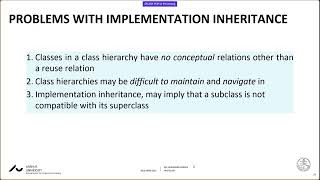
- 6:54The problem with classes
- 14:03The dangers of references
- 20:52Ship of Theseus and identity
- 24:58Managing relationships
- 31:38Defining equality
- 37:32Intrinsic vs extrinsic state
- 43:50Designing for minimal change
- 50:17Invariants and basis functions
- 57:24Calculating vs doing
- 1:09:49Value-oriented programming
- 1:14:50Q&A and conclusion
related talks
 01h 01mValue Oriented Programming. Part 1: You Say You Want To Write A Function
 01h 02mObjects vs Values: Value Oriented Programming in an Object Oriented World
 59mThe Most Valuable Values
 11mThe Value of Objects -
 38mWhat Object-Oriented Programming Was Supposed to Be: Two Grumpy Old Guys’ Take on ...
 32mThe Evolution of Object-Oriented Programming
 01h 02mAdvanced Levelization Techniques (part 2 of 3)
 58mModern C++ Design (part 2 of 2)