Architecture as Knowledge

summary
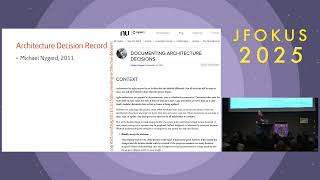
Claims that architecture is codified knowledge and that the code base is an executable record of team beliefs, demonstrated with a simplified in‑memory library system where packaging choices (horizontal technical layers vs vertical subdomains) are evaluated. Uses Architecture Decision Records stored alongside code (short Markdown ADRs, versioned) and concrete refactor: invert package dependencies, centralize loans by layers of change and backlog frequency, add declarative types not new runtime behavior, and cite Alexander’s 253 patterns.
AI-written summary · about
chapters (12)
- 0:00Architecture as knowledge
- 2:08The library system challenge
- 7:11Working with incomplete knowledge
- 10:34Constraints in distributed systems
- 13:30Categorizing ignorance
- 16:52Design decisions and trade-offs
- 19:33The role of design patterns
- 25:23Evaluating good design
- 28:33Layering and change rates
- 33:42Architecture decision records
- 36:52Applying partitioning strategies
- 42:42Conclusion and reflections
related talks
 45mArchitecture and the Architect AD2022
 14mArchitecture Decision Records
 14mArchitecture Decision Records: Make Peace with Your Docs
 39mOne Does Not Simply Make Architecture Decisions Alone: ADRs and Architec
 50mCoevolution of Architecture & Code - Closing The Gap
 43mWorking Efficiently with Architecture Decision Records (ADRs)
 37mArchitecting for Tomorrow: A Pragmatic Perspective
 44mArchitectural Practices for Greater Scalability and Innovation