Apache MXNet, a highly memory efficient deep learning framework
summary
Apache MXNet and its memory-saving design for GPU-based deep learning are presented, focusing on techniques that minimize GPU memory footprint so complex models can be trained on less powerful (more accessible) GPUs. The talk explains how MXNet achieves low memory usage and highlights other practical features of the framework.
AI-written summary · about
chapters (11)
- 0:00Start
- 3:59Dependency Scheduling Engine
- 4:32Solution: Auto Parallelization with Dependency Engine
- 4:58Symbolic vs. Imperative Deep Learning
- 6:27MXNet's Approach: Mixed Programming
- 7:21MXNet's Approach: Static Graph
- 7:49Memory Optimization with Computation Graph
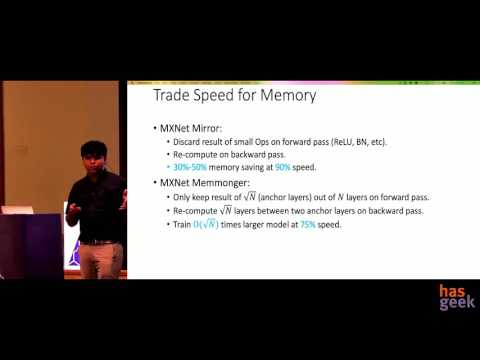
- 13:00Smallest GPU Memory Footprint
- 14:46Parallel & Distributed Training
- 16:20Parallel Training: Under the Hood
- 17:29Plugin Extensions
related talks
 42mAnima Anadkumar, Principal Scientist, Amazon Web Services, Endowed Professor, CalTech
 33mHigh Performance Deep Learning on Edge Devices With
 30mApache MXNet 2.0: Towards Synergistic ML and DL with Standardization
 29mAccelerate NumPy Data Science Workloads and Deep Learning Applications
 01h 16mDeep Dive into Deep Learning with MXNet
 18mModel Serving for Deep Learning
 39mAccelerate large-scale machine learning with NP on MXNet
 42mAlex Smola, Professor in the Machine Learning Department, Carnegie Mellon University