Introduction to Biological Network Analysis I: Network Basics and Properties
summary
Graph representations map molecules or patients to nodes and physical, regulatory or co-expression ties to edges, and show that clustering coefficient correlates with essentiality while betweenness centrality predicts bottlenecks that matter for information flow. Random‑graph comparisons use Erdos‑Rényi, Watts‑Strogatz small‑world and power‑law growth models; viral host interactions either target scale‑free hubs vulnerable to targeted attack or many low‑degree partners. Simulations (R) and shortest‑path algorithms (Floyd‑Warshall) are used, and crucially biological noise breaks engineering models.
AI-written summary · about
chapters (29)
- 0:00Intro
- 1:09Molecular biology is evolving
- 3:45Biological systems often represented by graphs
- 7:10Representation and Abstraction
- 7:53Network representations
- 8:44Bipartite graphs
- 9:52Heterogeneous networks
- 10:48Network Evolution
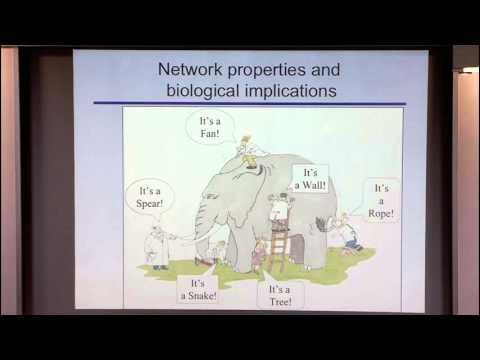
- 12:03Network properties and biological implications
- 13:52Diameter
- 15:15Clustering coefficient
- 19:08Degree-centrality examples
- 20:36Eigenvector Centrality
- 23:50Betweenness Centrality and Bottlenecks in Molecular Networks
- 26:23Disease gene centrality?
- 30:26Random Graph Models
- 32:24Erdös-Renyi model
- 32:59E-R phase transitions
- 35:28Do biological networks look like E-R?
- 36:05Power law degree distributions
- 36:32Random graphs vs. scale-free
- 38:31Biological networks often have hubs
- 39:16Degree, vulnerability characterize virus-host interactions
- 42:12Small-world models
- 43:46Example: ring model
- 44:52Small-world biological networks
- 46:14Power law networks in biology
- 49:12Geometric Random Graph Model
- 51:20Local motifs or structure
related talks
 26mNetwork neuroscience: where the brain and social networks works the same
 02h 47mNetwork Analysis Made Simple
 39mIdentifying Disease Mechanisms Using Gene Networks as Priors
 01h 41mGraph Intelligence: Enhance Reasoning and Retrieval Using Graph Analytics
 41mGeneral Network Models with Transitive Structures
 44mNetwork Propagation as a Tool for Deciphering Disease Mechanisms
 33mUnderstanding Molecular Complexity for Precision Medicine
 31mSimple Models and Exact Algorithms for Computing Network Modules