Fundamentals of Stringology IV: The Burrows-Wheeler Transform
summary
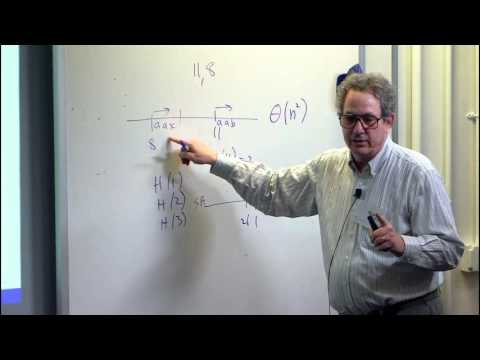
Defines the LCP array (longest common prefix) and gives a linear-time two-finger skip trick to compute each H[k] by skipping H[k]−1 characters when possible, so LCP builds in O(n) without a suffix tree. Defines the Burrows–Wheeler transform as the last column of the matrix of sorted rotations, shows equivalence with suffix arrays, describes invertibility via LF pointers, and explains practical benefits: strong run‑length grouping, much smaller on small alphabets (2 bits per base) and searchable in compressed form (FM‑index/BW back‑search).
AI-written summary · about
chapters (4)
related talks
 24mString Comparison in Real Life
 26mA Fast Algorithm for Computing the Maximum Weight Base in a Linear Matroid
 44mScalable Algorithmic Primitives for Data Science
 32mAdventures with Randomized Algebra for Extreme-Scale Signal Processing
 30mMatrix-free Construction of HSS Representations Using Adaptive Randomized Sampling
 43mTopological data analysis: How to quantify "holes" in your data and why?
 07mTamara Kolda, Distinguished Member of Technical Staff, Sandia National Laboratories @ MLconf SF Part
 24mHighlights from Current Programs part 2: