Learning Uninformative Representations

summary
Claims an algorithm called EIEL that infers worst-case domains from a reference model that has learned shortcuts, then alternates environment assignment (Bernoulli Q, inner loop maximizing an IRM-style proxy) with invariant training (outer loop). Tools include adversarial objectives, MMD references and the IRM gradient proxy. Tests on ColorMNIST (ERM drops to ~10% when colors flip; invariant methods reach ~70%) and Waterbirds show improved worst-group accuracy, but success depends on the reference model finding spurious features.
AI-written summary · about
chapters (15)
- 0:00Intro
- 0:38Removing Information from Representations Long-standing aim of representation learning: preserve information in data
- 1:46Info Removal: Remove spurious features Aim to learn predictor, factor out particular known spurious features Example: diabetes predictors, uncovering factors beyond BMI
- 2:52Info Removal: Information Bottleneck .
- 3:31Info Removal: Self-Supervised Learning
- 4:31Info Removal: Invariant learning
- 6:24Illustration of Invariant Learning
- 8:30Info Removal: Fair representation learning
- 10:21Info Removal Methods: Distribution Matching
- 12:39Info Removal Methods: Adversarial
- 15:03Invariant Learning with Unknown Environment
- 17:24Notation & Definitions
- 19:27Invariant Learning Fairness Mary parallels between Invariant learning and algorithmic fairness
- 30:55EIIL: Dependence on reference model
- 33:09Discussion & Open Questions
related talks
 34mOffline Reinforcement Learning and Model-Based Optimization
 18mRectifying Privacy and Efficacy Measurements in Machine Unlearning...
 38mRepresentation via Representations: Improving Generalization to Unseen Populations
 01h 08mUnwanted Learning: What It Is, Why It Matters, and What To Do About It
 31mIndividual Gaps in Prediction Generalization
 45mTBD
 01h 12mRecent Progress in High-Dimensional Learning
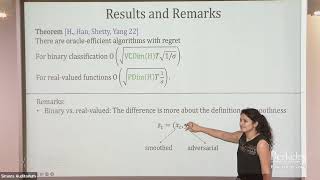 49mOracle-Efficient Online Learning or: How to Use Non-Robust Optimization for Robust Learning