MPC-in-the-Head based Zero Knowledge Proofs

summary
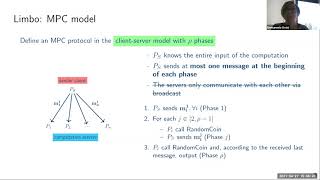
Framework claims that MPC-in-the-head yields practical zero-knowledge by having a prover hallucinate an honest-majority MPC, commit to each server’s secret-shared view, and let the verifier open random views; soundness comes from view consistency, zero knowledge from limited opened views. Construction combines an honest-majority outer MPC (K servers, tolerate a constant fraction corrupted and one corrupted client) with a semi-honest inner two-party protocol and uses oblivious watchlists and parallel OT to get malicious security, even non-interactively.
AI-written summary · about
chapters (15)
- 0:00Intro
- 2:35Proof for 3 colorability
- 8:11Natural transformation of computation
- 15:07Beyond Zero Knowledge to Party Computation
- 18:55Unrealistic Goal
- 20:26The Idea
- 24:08The Protocol
- 27:44The Inner Protocol
- 28:17The TwoParty Protocol
- 29:22Player Virtualization
- 30:03Watchlists
- 32:00Joint hallucinations
- 34:23Riskiness
- 35:54Zero Knowledge Proof
- 37:08NonInteractive
related talks
 53mFormal security analysis of MPC-in-the-headzero-knowledge protocols
 23mRecent progress in MPC-in-the-Head protocols
 51mDistributed Zero-Knowledge Proofs and Applications to Secure Computation
 54mVerification Dilemmas, Law, and the Promise of Zero-Knowledge Proofs
 51mWhy you shouldn't trust me
 05mπMPC: Automatic Security Proofs for MPC Protocols
 34mPrivacy Preserving Aggregation of Ad Conversions using MPC
 32mSoK: Private Programmability on Blockchain Systems