Modern Java: Change is the Only Constant

summary
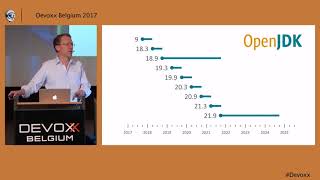
Platform is split into 26 standard modules, later trimmed so core distribution has 19 standard modules after Java EE and CORBA removed, enabled by JDK 9 modularization and tools like jlink/Java packager that produce tiny custom runtimes for smaller Docker images and app-store bundles. Release cadence shifts to a six-month release cadence with designated LTS every three years (11 is first LTS), features arrive only when nearly finished, and many JEPs and external contributions already deliver measurable GC, HTTP, TLS and performance changes.
AI-written summary · about
chapters (21)
- 0:00Modern Java changes
- 1:05Six-month release cycle
- 2:30Modularization benefits
- 4:39Security via modules
- 6:28JDK internal API deprecation
- 8:59Modularization compatibility
- 9:42Removing Java EE and CORBA
- 11:09Deprecating obsolete APIs
- 12:36Java feature timeline
- 14:02Key Java features
- 16:54LTS vs feature releases
- 18:39Oracle LTS support
- 21:28Choosing LTS or feature
- 22:52Java future and ecosystem
- 25:43Q&A: Amazon Corretto
- 28:15Q&A: JavaFX and Swing
- 31:50Q&A: GraalVM vs WebAssembly
- 36:26Q&A: JVM vs Java platform
- 40:18Q&A: New code on old JVMs
- 43:51Q&A: Future of checked exceptions
- 45:34Q&A: Java fibers timeline