Reactive Programming in Java

summary
Argues reactive programming groups four needs — message-driven architecture, elasticity, responsiveness, resilience — and demonstrates a runnable Java RxJava example: an Observable that lazily emits stock prices fetched from Yahoo Finance, shows subscribe triggering emission, uses map/filter, sends onComplete and onError (error flows down the error channel), and swaps to a backup via onErrorResumeNext. Mentions Flowable for backpressure handling, contrasts with Java 8 streams, and cites a real-world scale problem (50 million users on peak days) motivating the approach.
AI-written summary · about
chapters (23)
- 0:00Introduction
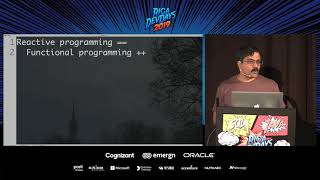
- 0:54What is Reactive Programming
- 2:28Why Reactive Programming
- 9:13Failure Story
- 10:00What does this all mean
- 11:39Reactive Applications
- 11:58Raising the level of abstraction
- 14:33Asking for help
- 17:53Efficiency
- 18:57Observable
- 20:40Errors
- 21:27Error Channels
- 26:13How do we do this
- 29:37Subscribe
- 30:44Stream vs Observable
- 33:12Fetch
- 34:40Thread
- 34:57Testing
- 35:22Reactive Programming
- 40:57Error Handling
- 41:48Filtering Data
- 48:23Back Pressure
- 50:25Summary
related talks
 49mReactive Programming in Java
 47mReactive programming in Java
 41mThe definite guide to reactive programming in Java
 24mBringing Reactive Programming to Java and Microservices
 01h 04mFrom Functional to Reactive Programming
 43mReactive Programming in Java
 52mReactive for the Impatient - A Gentle Intro to Reactive Java
 01h 28mIntroduction to Reactive Programming