AI Images: Redefining Quality with Innovation
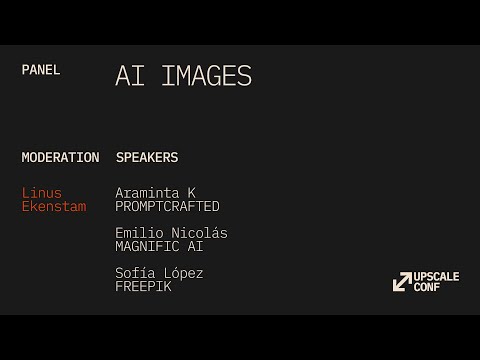
summary
Magnific AI’s upscaler (now part of Freepik) generates new pixels rather than simple interpolation, powers restoration and colorization workflows, and exposes sliders plus strong defaults to balance control versus hallucination. Panelists report persistent bias and inconsistent character/style generation, expect 2K→4K demands, and highlight fine‑tuning and ControlNet as fixes for consistency over scale and designer-level control. Ethics concerns include deepfake risk and provenance needs, while surprising user workarounds show the tool enabling unexpected workflows and real production-ready outputs.
AI-written summary · about
chapters (16)
- 0:00Introduction and panel setup
- 1:59Redefining AI upscaling complexities
- 4:53Evolving quality standards in visual art
- 7:00Model biases and consistency challenges
- 9:09Balancing scale and quality in AI generation
- 11:41Control over aesthetics and fine-tuning
- 16:00User feedback and tool development
- 18:31Free AI Suite and accessibility
- 20:18Future of simple AI design interfaces
- 21:23Ethics and value of AI-generated art
- 24:12Time spent with generative images
- 25:39Keeping up with rapid AI advancements
- 27:01Self-training and AR experiences
- 29:09Sifting through AI-generated noise
- 29:53Impact of fake media on trust
- 31:57Ethics and future challenges
related talks
 22mHarnessing the Potential: AI's Role in Enchanting Media Experiences
 01h 07mMinimizing Bias in AI-Generated Images
 47mAI Image Generation: Visual Artistry with Midjourney, Adobe Firefly, and DALL-E3
 23mAI & Creativity – Powering Human Innovation Through Design
 36mArt in the Age of Algorithms
 49mCreation as Curation [Keynote]
 01h 09mAI is eating the world (and Google)
 53mCreating Beautiful, On-Brand Photography with AI