Pairwise Network Differential Privacy

summary
Shows that a standard gossip algorithm that alternates a gradient step with a gossip step enables a gradient-reconstruction attack that recovers exact images (one CIFAR image per node) by undoing mixing via linear algebra, so decentralization alone leaks. Introduces a pairwise epsilon matrix definition of network DP (Rényi accounting) that ties privacy guarantees to the gossip weight matrix and graph communicability, yields lower epsilons than naive accounting, and demonstrates practical gains with a noisy algorithm. Includes a 13-graph Fediverse dataset (one year, pip installable) used for evaluation.
AI-written summary · about
chapters (10)
- 0:00Pairwise network DP intro
- 1:04Centralized to decentralized learning
- 4:44Fediverse as example
- 13:36Decentralized learning risks
- 20:35Pairwise network DP introduced
- 23:06Privacy by graph distance
- 27:45Gossip algorithm privacy
- 30:37Utility vs privacy trade-offs
- 31:44Open questions and future work
- 35:19Q&A
related talks
 33mPrivacy of Decentralized Machine Learning
 01h 14mTutorial: Privacy, Part II
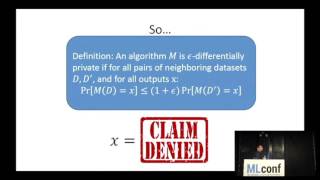 26mAaron Roth, Associate Professor, University of Pennsylvania, NYC 2017
 58mLarge-Scale Private Learning, Part III
 31mGaussian Differential Privacy (GDP)
 50mPrivacy Amplification by Sampling and Renyi Differential Privacy
 31mWhen Existing Techniques in Linear Regression Preserve Differential Privacy
 54mNode Privacy, High-dimensional Graph Summaries, and Block Models