Two Defeasible Challenges for algorithmic Scientific Discovery
summary
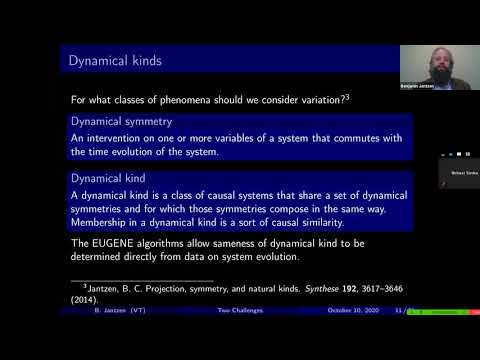
Argues there are two defeasible obstacles to automated theory and ontology creation: conceptual inertia — the assumption that new concepts must resemble existing ones — and skillful manipulation — the need for nuanced, open-ended physical interaction to produce stable data. Shows algorithmic examples: eugene algorithms cluster dynamical kinds from time series and a built soil‑column apparatus recovers a pressurelike linear scale from flow data, while symbolic systems like Bacon 4 can introduce novel intrinsic variables; full autonomy fails where robots cannot yet perform the needed experimental maneuvers.
AI-written summary · about
chapters (21)
- 0:00Intro
- 0:25takeaway
- 0:50clarification: scientific inference
- 2:48An old bromide
- 3:22Novelty and its mechanical production
- 5:35A rule of variable introduction
- 9:22Rozeboom's ontological induction?
- 12:58Variation across dynamical kinds
- 15:31So what's the problem?
- 16:04Outline
- 17:20The stultifying demand for intelligibility
- 19:47Three arguments for conceptual inertia (CI)
- 20:40The argument from prior knowledge
- 21:17Representing prior knowledge
- 22:01The argument from scientific convergence
- 23:26Dropping a dubious premise
- 25:17Recognizing contexts and building variables
- 26:18Example
- 27:32The nature of the challenge
- 30:30Human-assistance
- 31:50Conclusion
related talks
 51mPlaying Newton: Automatic Construction of Phenomenological, Data-Driven Theories and Models
 43mAI Systems: Foundations for Artificial Minds
 49mPedro Domingos, Professor, University of Washington
 22mUnique Challenges of AI in Materials Design
 03mOpen-endedness: A new grand challenge for AI
 19mAutonomous Agents for Scientific Tasks
 43mIn defence of uncertainty
 39mData Challenges and AI Impact in Research-Driven Organizations