TMLL Trace Server Machine Learning Library, Use AI for Trace Analysis
summary
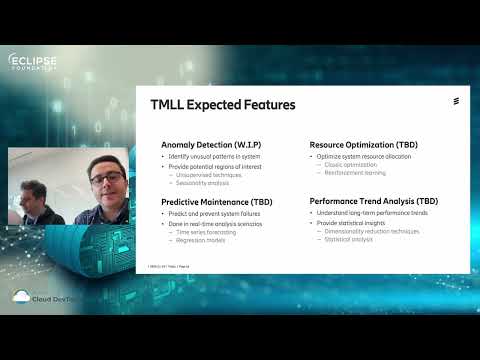
TMLL sits between Trace-Server and analysis code, ingesting Trace Compass outputs and running automated pipelines that produce anomaly windows, seasonality plots, correlation matrices and predictive-maintenance scores. It implements statistical and ML detectors (z‑score, IQR, moving averages, isolation forest), reduces thousands of raw events to tens of summary states, exposes Jupyter-friendly outputs for Theia and PyTorch, and handles large traces by using a sliding window to avoid multi‑gigabyte transfers.
AI-written summary · about
chapters (11)
- 0:00Introduction
- 0:41Trace Compass and tracing
- 2:04Trace Server overview
- 3:27User challenges with Trace Server
- 4:52TMLL introduction
- 5:36Anomaly detection with TMLL
- 6:42Seasonality analysis
- 8:49Correlation analysis in TMLL
- 10:13TMLL library usage
- 10:54Summary
- 11:16Q&A
related talks
 10mML-based Log Analysis for Faster Debugging
 26mML Monitoring & Observability
 31mRunning Machine Learning Analytics On Traces
 39mMethodology of ML in Performance Testing (How to Find Bottlenecks Automatically)
 05mDBTB INT Chester Chen r
 43mBeyond Logs: Real-Time Anomaly Detection with Machine Learning
 30mBetter data quality with ML & visualization
 29mThresholds Are for Old Threats: Demystifying AI and Machine Learning to Enhance SOC Detection