Feast: feature store for Machine Learning

summary
GO-JEK builds Feast with Google Cloud tooling to stop feature drift and speed production ML: a Python SDK, gRPC online serving and BigQuery warehouse, later adding Redis and Kafka for decentralization. Feast guarantees point-in-time joins, returns features for training and serving, and serves low-latency lookups (2–3 ms latency). Version changes cut sparsity with feature sets and achieved about 70–80% compression. Lessons: teams prefer isolated deployments, feature validation is essential, and BigQuery required for batch retrieval in current releases.
AI-written summary · about
chapters (15)
- 0:00Intro
- 1:41What is a feature?
- 2:26How do we train a model?
- 4:21How do we predict in online serving?
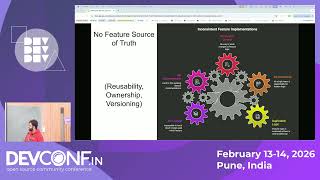
- 5:46What are the challenges with features?
- 8:09Feature Store: Design Goals
- 10:08Where did we begin?
- 12:47Feast MVP: Lessons learned
- 16:13Feast at a high level
- 17:08How has Feast evolved?
- 18:41Register a driver feature set
- 20:10Register a feature set for a stream
- 21:10Retrieve batch features to train model
- 22:45Retrieve online features to predict
- 23:18What's next?
related talks
 31mFeast as a Cloud Native Data System: Bridging Batch Processing and Online Serving...
 32mBuilding a Cloud Native Feature Store with Feast on Kubeflow
 36mIntegrating Feast Online Feature Store with KFServing
 45mBuilding a Feature Platform to Scale Machine Learning
 51mSelf-serve Feature Engineering Platform Using Flyte and Feast
 34mSolving the ML Pain You Forgot to Mention
 30mHow Feature Stores Enable Operational ML
 23mFeathr: An Enterprise-Grade, High Performance Feature Store