BerkeleyDB

summary
Berkeley DB is a simple key-value engine that stores data in fixed-size pages with a shared in-memory hash cache and a B+ tree whose root lives at page zero; keys can be arbitrarily large via off-page chaining. It uses page-level locking with deadlock detection and configurable victim selection, and a log-first durability design: every update records an LSN in fixed-length log files that carry enough info to both undo and redo, enabling full replay, checkpoints, and log-driven master/replica replication with quorum commits. Slicing splits databases across environments for scale.
AI-written summary · about
chapters (18)
- 0:00Introduction
- 1:33History
- 3:45Tigerwire
- 4:18Design
- 6:07Pages
- 7:39Cache
- 10:03Btree
- 14:36Insert a Key
- 15:41Locking
- 17:55deadlock detection
- 23:04log entry
- 24:58offset
- 25:44operation data
- 27:43consistency
- 29:35checkpointing
- 31:04recovery
- 36:22Slices
- 37:36Sales Pitch
related talks
 48mThe LMDB Engine — a Special Champion
 16mScaleDB: A Scalable, Asynchronous In-Memory Database
 26mFuture of FoundationDB Storage Engines
 01h 02mRonDB: A Key-Value Store with SQL Capabilities and LATS Properties
 49mBuild a database from the ground up
 48mA Deep Dive Into Database Internals
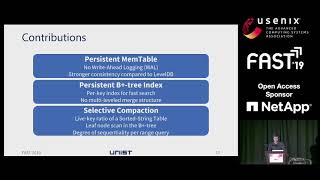 29mSLM-DB: Single-Level Key-Value Store with Persistent Memory
 46mFoundationDB: The Best-Kept Secret of New Distributed Architectures!