MicroPython on the RP2040

summary
MicroPython runs on the RP2040 and exposes PIO state machines (two blocks of four SMs) for deterministic I/O with single‑cycle instructions; an example implements a NOT gate with about 40 ns input‑to‑output delay. The board has dual cores and MicroPython can launch work on the second core via _thread, useful to isolate an async loop. DMA lacks high‑level bindings, but registers are usable through uctypes memory‑mapped DMA access. A software DAC built with PIO+SPI produces a working staircase output, though slower than an LTC2644.
AI-written summary · about
chapters (12)
- 0:00Introduction
- 1:50Micropython overview
- 3:30RP2040 hardware
- 5:17Peripherals and development
- 7:37Micropython hardware control
- 11:07Clock management
- 12:40Dual-core processing
- 16:51Programmable IO
- 21:17PIO implementation examples
- 25:38Low-level register access
- 28:12Real-world application
- 31:51Language choice and summary
related talks
 32mUsing MicroPython in the wild
 25mMicroPython for ESP32
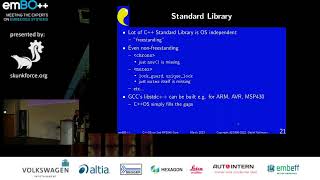 43mUsing Both Cores of Raspberry Pi Pico with C++OS
 30m"MicroPython: The best bits!"
 01h 05mIoT is fun using MicroPython
 01h 26mRaspberry Pi Pico with C++OS: Coroutines and std::execution in Embedded Systems
 34mUsing Python to enter the world of Microcontrollers
 27mYou can't do that in MicroPython!