A Secure Continuous Delivery Pipeline

summary
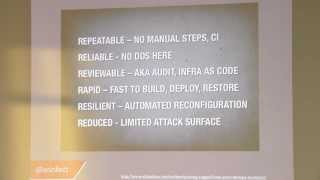
Argues that security is automated into CI/CD so every commit gets checked end to end and shipped safely, showing a working pipeline built with GitHub, Slack, Gitrob and TruffleHog for secret detection; Travis CI / GoCD, Brakeman and Burp for build + static/dynamic analysis; Artifactory plus X‑Ray for artifact inventory and vulnerability scans; Greenkeeper/gymnasium/snyk for automated upgrades; Twistlock, ThreatStack, tCell and Signal Sciences for runtime protection. Notes a striking metric: 99.9% of breaches exploit years-old vulnerabilities. Describes Deploy Duty and an event bus that actually lets merges auto-deploy and alerts only on failures.
AI-written summary · about
chapters (14)
- 0:00Introduction and background
- 5:25What is a continuous delivery pipeline
- 8:57High-level security resources
- 12:33Code review and secrets management
- 14:38Continuous integration in the pipeline
- 17:47Security checks and static analysis
- 20:54Centralized artifact repository
- 22:39Scanning for known vulnerabilities
- 25:07Automated dependency upgrades
- 26:29Deployment and monitoring
- 29:21Configuration automation benefits
- 30:47Runtime security and intrusion detection
- 32:53Runtime application self-protection
- 34:18Summary and Q&A
related talks
 59mDevOps for the Discouraged
 38mSecuring your CI/CD Pipeline
 43mThe art of secure software: Zero-trust delivery pipelines
 31mContinuous Security – integrating security into your pipelines
 40mSecure by Default: Building an AI-Augmented, OSS-Powered Reusable CI/CD Pipeline
 29mSecuring Your Web Application Pipeline From Intruders
 39mContinuous Security at the Next Level
 50mBuilding a continuous secure delivery pipeline