MySQL HA, Recovery and Load Balancing

summary
Compares concrete setups: Oracle MySQL Server with semisynchronous replication and GTID-based failover, plus Percona XtraDB Cluster (Galera) with HAProxy and MySQL failover tools. Benchmarks show semisync ~2,850 qps, async ~2,900 qps and read-only ~10,850 qps with 1.5M rows replicated in about a minute; Galera reproduces primary-key collisions and becomes unusable past a handful of concurrent clients (breaks around 4–16), so it often does not work as a drop‑in multimaster.
AI-written summary · about
chapters (12)
- 0:00Intro
- 0:12Davey Shafik
- 8:30Semi-Sync Master Setup
- 9:13Semi-Sync Slave Setup
- 12:00Benchmarks
- 12:56Performance
- 15:45Global Transaction IDs (GTIDs)
- 17:27GTID Master & Slave Setup
- 18:54Hooks
- 23:36Primary Server Setup
- 24:32Other Server Setup
- 29:38Read/Write Splitting
related talks
 24mComparing the High Availability of MySQL with Modern Distributed SQL Databases
 52mBest Practices for MySQL High Availability in 2022
 32mBest Practice in Design and Implementing MySQL Geographic Distributed, High Availability Solutions
 58m600k QPS on MySQL Galera cluster
 50mMySQL/MariaDB Parallel Replication: inventory, use cases and limitations
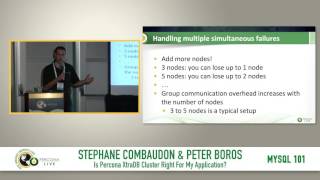 38mIs Percona XtraDB Cluster Right for Any Application
 48mMySQL Load Balancers - MaxScale, ProxySQL, HAProxy, MySQL Router & nginx - a close up look
 43mMySQL Failover for Asynchronous replication with Orchestrator, ProxySQL and Consul