Spring Data Neo4J

summary
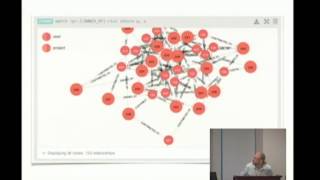
Claims that Neo4j plus Spring Data handles connected queries thousands of times faster: a 1,000‑node social graph with 50 friends each (25,000 edges) yields ~2,000 ms on a relational DB vs ~2 ms on Neo4j; scaled to 1M nodes/25M edges still ~2 ms on a laptop. Uses Neo4j (embedded or server), Spring Data Neo4j repositories and templates, Cypher (and Gremlin), Lucene indexes, Spring Social for Twitter import, and D3 for visualization of a 500k bike‑trip dataset. Demonstrations include index lookups via Lucene, Cypher pattern queries and depth limits, and a working D3 visualization of imported trips.
AI-written summary · about
chapters (13)
- 0:00Introduction and agenda
- 1:59The need for connected data
- 9:07What is a graph database
- 15:05Performance and scalability
- 19:28The Cypher query language
- 21:45Neo4j architecture and FAQ
- 32:34History of Spring Data Neo4j
- 34:18Spring Data Neo4j features
- 44:17Repository and template patterns
- 49:37Sample Twitter application
- 1:04:03Visualization example
- 1:09:57Geospatial capabilities
- 1:15:02Final Q&A and closing
related talks
 28mNeo4j for Beginners: Pros and Cons, Based on Social Networks
 52mEnhance your work with graph database
 26mHow NEO4J Saved my Relationship
 29mSpring in Autumn
 01h 34mSpring Data Daily Double - Couchbase and Neo4J
 01h 31mArtistic Spring Data Neo4j 3.x with Spring Boot and Van Gogh
 50mThinking in Relationships: Practical Graph Database Modelling in Java with Neo4j
 49mWarming up to Graphs