Communicating Device Confidence Level and Upcoming Re-Authentications in Continuous
summary
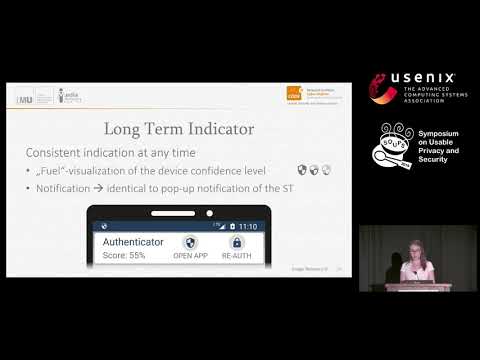
An Android prototype called Authenticator Android app simulates behavioral biometric continuous authentication, locks at a 20% device confidence level and offers an 8‑second dimming grace period. A four‑week within‑subject study with N=32 compares four conditions: no indicator, short‑term (pop‑up + grace), long‑term (status icon), and combined. Participants prefer indicators over none, rank the combined indicator highest, and use voluntary re‑authentications extensively — about one‑third voluntary — while annoyance tracks task sensitivity and importance rather than indicator presence. Recommendations: delay non‑sensitive interruptions, enforce immediate re‑auth for sensitive tasks.
AI-written summary · about
chapters (23)
- 0:00Introduction
- 1:22Current Authentication
- 1:42Explicit Authentication
- 1:54Continuous Authentication
- 3:45Implicit Authentication
- 4:16Explicit Real Indication
- 4:27Immediate Real Indication
- 5:10Usability Issues
- 5:47Concept
- 6:30Research Questions
- 7:10Prototype
- 7:44Experience Sampling
- 8:08Experimental Conditions
- 8:20Shortterm Indicator Condition
- 8:36Longterm Indicator Condition
- 8:54No Indicator Condition
- 9:13Short Indicator Condition
- 9:53Long Indicator Condition
- 10:58Field Study Timeline
- 12:09User Study Insights
- 14:07Design Recommendations
- 15:24Summary
- 15:45Questions
related talks
 37mTo Protect And Confirm
 06mTowards Usable and Secure Location-based Smartphone Authentication
 23mMobile App Auth Friction
 45mOverview of Biometric Auth
 20mChameleon Devices: Investigating More Secure and Discreet Mobile Interactions via Active ...
 33mBuffed up Biometrics
 38mThe Present and Future of Standardized Authentication Specifications You Can Experience on Android/Chrome
 14mDemystifying attestation