Learning How to Build Secure Smart Contracts

summary
Covers a concrete checklist: top eight vulnerabilities (timestamp dependence, unexpected ether, tx.origin phishing, delegatecall/library risks, overflow/underflow, DoS patterns, front‑running/MEV, and reentrancy) with code examples and real incidents (Parity, DAO). Recommends specific fixes: use transfer or limit gas and always update state before external calls to block reentrancy, use the library keyword and stateless libraries, SafeMath or Solidity 0.8, withdrawal patterns, proxies for upgrades, audits, and mentions Chainlink fair sequencing / oracle tools as practical mitigations.
AI-written summary · about
chapters (24)
- 0:00Intro
- 1:47Smart Contract Security
- 4:26Timestamp Dependence and Manipulation Solutions
- 6:28Unexpected Ether: Solutions
- 8:256: Tx.Origin: Solutions
- 9:38S: delegateCall: Parity Wallet Exploit
- 10:16Overflow/Underflow Attack
- 10:54Overflow/Underflow: Beauty Ecosystem Coin
- 11:05Overflow/Underflow: Solutions
- 11:37Dos Attacks: Looping
- 12:04Dos Attacks: Owner Operations
- 12:31Dos Attacks: External Calls
- 12:48Dos Attacks: Solutions
- 14:06Race Conditions/Front Running Current Solutions
- 14:31Race Conditions/Front Running Chainlink FSS
- 15:40Re-entrancy Attack: Solutions
- 16:11Re-entrancy Attack: The DAO
- 16:32Other Vulnerabilities and Exploits
- 16:44Testing Your Smart Contracts
- 16:59Fixing Issues: Shipping a New Version
- 17:13Fixing Issues: Upgradeable Contracts
- 17:38Kill Switch
- 17:52Get External Audits
- 18:29Summary
related talks
 20mLearning How to Build Secure Smart Contracts
 12mSmart Contract Security
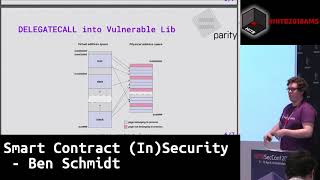 25mCommSec D2 - Smart Contract (In)Security
 51mA Deal with the Devil: Breaking Smart Contracts
 20mSolidity's most common security pitfalls and its best safeguards
 43mOutsmarting Smart Contracts
 24mAn Introduction to Smart Contracts
 51mBlockchain and smart contracts (...)